
Views: 0 Author: Site Editor Publish Time: 2026-08-07 Origin: Site


Trapped gases cause porosity in aluminum die casting. Rapid injection traps air, which causes porosity throughout the metal. Shrinking metal during cooling also makes holes. Find defect causes quickly. This protects mechanical performance. Smooth, round voids mean gas porosity. Trapped air makes them. Burning lubricants cause them too. Jagged cavities mean shrinkage porosity. Hot areas cool down. They shrink as they cool.
Check parts against standard quality limits:
Category (ASTM E155) | Max Pore Diameter | Max Defect Area |
|---|---|---|
Level 1 (Highest Quality) | Internal ≤ 0.5 mm | ≤ 0.3% |
Level 3 (Commercial Grade) | Internal ≤ 1.8 mm | ≤ 1.5% |
Knowing what causes porosity in die casting helps you. You fix injection settings. You manage cooling speeds. You keep aluminum components strong.
Trapped air and shrinking metal cause porosity defects.
These issues happen in aluminum die casting.
Smooth plunger speeds prevent gas bubbles inside molds.
Using vacuum systems also stops these gas bubbles.
High squeeze pressure fixes shrinkage voids easily.
Do this before the metal gates freeze up.
Balanced mold cooling keeps aluminum components very dense.
This cooling makes the metal strong and durable.
Gas defects create major quality issues. Aluminum die casting uses molten metal. Trapped gas creates small internal voids. You must control gas flow.
Fast plunger speeds move molten metal. Unstable liquid flow causes porosity. Metal splashes inside the runner system. Splashing traps air inside the cavity. High speeds create internal porosity. You need smooth plunger speeds. This prevents bad air pockets.
Air must exit the tool fast. Blocked air channels cause gas porosity. Small overflow wells miss dirty metal. Trapped air causes porosity fast. Good design stabilizes aluminum die casting.
Pro Tip: Clean vacuum lines and vents often. This keeps air paths clear.
Hot metal absorbs nearby gases easily. Incomplete degassing leaves gases inside. Liquid metal reaches high heat. Hot aluminum absorbs lots of hydrogen.
Hydrogen leaves metal as it cools. Outgassing creates round gas porosity. You must clean liquid melt. Pinhole porosity weakens the part strength. Rotating degassers clean metal very well.
Water drops create fast steam bubbles. Steam expansion creates porosity in sections. Chemical sprays break under heat. Fast decomposition creates big gas volumes. Water creates smooth gas porosity voids. Lower spray volumes stop excess liquid. Teams boost aluminum die casting yields.
Hot liquid metal cools down. Its overall volume shrinks. Solidifying aluminum causes porosity defects. Knowing contraction helps stop voids.
Cool die walls freeze metal. Solid layers grow inward. The hot core cools last. Center liquid shrinks without feed. This creates jagged voids.
Metal shrinks as heat leaves. Thick centers pull away. Liquid metal misses internal gaps. This causes shrinkage porosity defects. Unpressurized areas form porosity easily.
Key Takeaway: Outer metal shells form quickly. The inner center cools last. Shrinking cores leave irregular voids.
Push extra liquid metal inside. The squeeze forces fresh metal. This fixes volume loss.
Keep squeeze pressure above 100 MPa. Machines supply extra high pressure. Peak force reaches 160 MPa. Right pressure keeps parts dense.
Timing is very crucial here. The table shows gate timing:
Gate Freeze-off Condition | Impact on Intensification Pressure | Result on Casting |
|---|---|---|
Premature Freeze-off / Delayed Trigger | Pressure bounces off hard metal. | Creates bad shrinkage porosity defects. |
Optimal Timing (Before Freeze-off) | Force enters heavy sections fully. | Feeds metal and prevents defects. |
Early gate freezing blocks pressure. Thick sections keep shrinking freely. Unfed areas form shrinkage porosity. Calibrate shot timing very carefully.
Uneven walls change cooling speeds. Thin areas cool off fast. Thick parts stay hot longer. Thick metal shrinks after gates. Unbalanced cooling creates shrinkage porosity. High heat extends solidification time.
Wall thickness changes internal structures:
Section Thickness Relationship: Thin sections lose heat fast. Thin walls speed cooling.
Dendritic Arm Spacing (DAS) Effect: Fast cooling lowers DAS size.
Positional Variations: Surface metal shows finer DAS. Central cores shrink heavily.
This table shows thickness effects:
Wall Thickness Variation | Impact on Local Cooling & Solidification | Impact on Dendritic Cell/Arm Size |
|---|---|---|
Thinner Sections (e.g., 3 mm) | Speeds up cooling rates | Yields finer cell sizes |
Thicker Sections (up to 11 mm) | Slows down local cooling | Grows dendritic cell sizes |
Thick walls cool very slowly. Large dendritic structures grow inside. Liquid metal flows poorly here. Isolated areas shrink without feed. Deep pockets form shrinkage porosity. Hot spots pull away fast.
Heavy sections shrink during changes. Large voids appear without pressure. Uneven cooling shrinks metal wildly. Tool cooling lines fix temperatures. Controlled heat stops casting defects.
Image Source: unsplash
Cooling metals behave in different ways. You pick metals for strength. Metal choice changes defect risks. This happens in aluminum die casting.
The freezing range shows two temperatures. It spans liquidus and solidus points. Wide ranges create mushy states. Liquid metal flows with difficulty. Semi-solid paths block liquid metal. The metal shrinks into voids.
Compare common metals with this table:
Alloy | Solidus Temperature (°C) | Liquidus Temperature (°C) | Freezing Range Span (°C) |
|---|---|---|---|
A380 | 538 | 593 | 55 |
413 | 574 | 582 | 8 |
319 | 520 | 605 | 85 |
A356 | 555 | 615 | 60 |
356 | 555 | 613 | 58 |
535 | 550 | 635 | 85 |
This chart shows temperature differences:
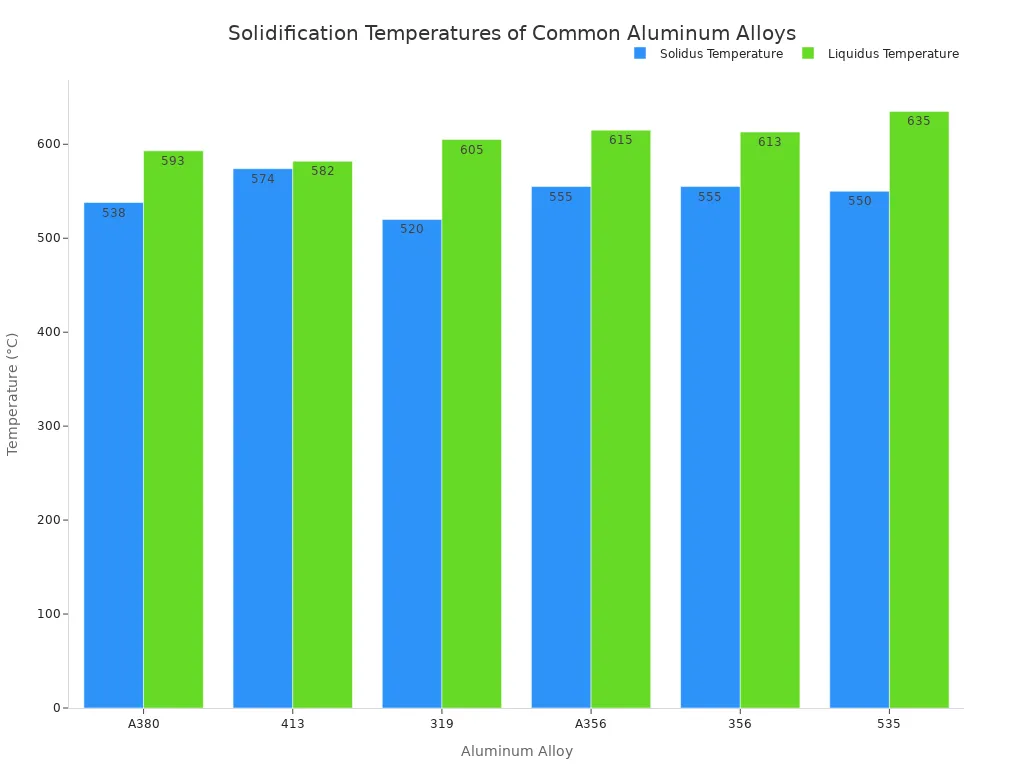
Alloy 319 spans 85°C while freezing. Wide spans cause shrink porosity. Match metal traits to lower porosity. Do this in aluminum die casting.
Many workers choose A380 metal. A380 freezes across 55°C. Solid networks grow fast inside. These networks block liquid flow. Closed areas shrink without pressure. This creates shrink porosity everywhere.
Alloy 413 acts like eutectic metal. Alloy 413 freezes across 8°C. Solidification happens very fast. Metal cools from 582°C to 574°C. Liquid flows until completely solid. Fast freezing reduces porosity issues.
Key Takeaway: Wide alloys need careful heat control. Use high pressure against shrink porosity. This stops porosity in stressed areas.
A380 creates more shrinkage porosity. Alloy 413 forms fewer defects. Mold cooling controls metal shrinkage. Proper cooling lowers shrink porosity. This improves aluminum die casting parts.
Vacuum systems clear gas voids before injection. Pumps pull air from molds fast. Pressure drops to 80 mbar quickly. This removes air before metal arrives. Vacuum tools cut air volume by 75%.
Parameter | Target Value | Operational Result |
|---|---|---|
Cavity Vacuum Pressure | ≤80 mbar | Removes 99.9% air and stops defects |
Shot Sleeve Vacuum | <50 mbar | Cuts structural porosity under 0.3% |
This quick pump prevents gas traps. Clean molds allow safe heat treatments. Blisters will not form on surfaces. You make strong aluminum die casting parts.
Plunger speeds must stay smooth now. Smart machines change speed in steps:
Initial Phase: Slow movement slides metal smooth and easy.
Intermediate Phase: Fast speed fills thin walls quickly.
Final Phase: Slow motion packs metal to stop porosity.
Multi-stage shots improve the overall process. Controlled speeds block air pockets from forming. Tuned plungers keep parts dense and strong.
Pro Tip: Match slow speeds to sleeve levels. Proper balance stops waves from trapping air.
Regulate tool heat to control metal cooling. Sensors check mold temperatures constantly. Cool lines push liquid into hot spots. Balanced heat stops fast melt freezing.
Thermal controls stop local contraction voids. Temperature management keeps process results steady. Monitoring improves aluminum die casting strength.
Trapped gas in melt causes porosity. Cooling metal shrinks without pressure.
Liquid melt degassing fixes gas porosity. Vacuum venting also helps. Shot tuning stops shrinkage porosity. Tool controls stop shrinkage porosity, too. Squeeze forces stop shrink porosity. Use force before gates freeze.
Modern tools keep quality high:
Inspection Technology | Dimensional Output | Real-time Capabilities & Primary Advantages |
|---|---|---|
2D X-ray Inspection | Two-Dimensional (2D) | Shows live views during production. Helps make fast machine updates. Lowers scrap counts without damage. |
Industrial Computed Tomography (CT) | Three-Dimensional (3D) | Rebuilds 3D shapes for exact mapping. Measures exact pore sizes and spaces. Checks important cast parts. |
Learn these methods today. Eliminate porosity in aluminum die casting. Make dense aluminum die casting parts.
Smooth round voids mean gas porosity. Trapped air forms smooth pockets. Decomposing lubricants make them too. Inspect aluminum die casting parts. 2D X-ray systems find bubbles fast.
Hot liquid metal cools down. The shrinking metal contracts fast. Outer layers freeze very quickly. Thick inner parts shrink last. Low pressure leaves internal gaps. This causes shrinkage porosity voids.
Tip: Apply high squeeze pressure fast. Stop shrinkage porosity before gate freezing.
Vacuum tools lower porosity levels. Molds lose trapped air quickly. Pressure drops cut air pockets. Proper cooling still stops defects. Squeeze force stops shrink porosity.
Thick walls cool down slowly. Large grain structures grow inside. Hot spots stay isolated longer. Contracting heat pulls metal away. Unfed areas form porosity defects.
